

Patient Visit Average (PVA) is total visits in a period divided by the new patients who generated them, the clearest measure of whether your practice keeps people or leaks them. Most US practices sit around 12 to 16; a well-run office aims for 30 or more. It matters because it is money: raising PVA from 12 to 18 is six extra visits from every new patient you already paid to acquire, with no new ad spend. PVA drops at predictable handoffs: the Report of Findings, the relief-phase window around visits 4 to 6, the missed call, the no-show, the unbooked checkout, and the dormant list. Each has a fix you can run this week. Here is how to calculate PVA, what a good number is, and the six leaks with the copy to plug them.
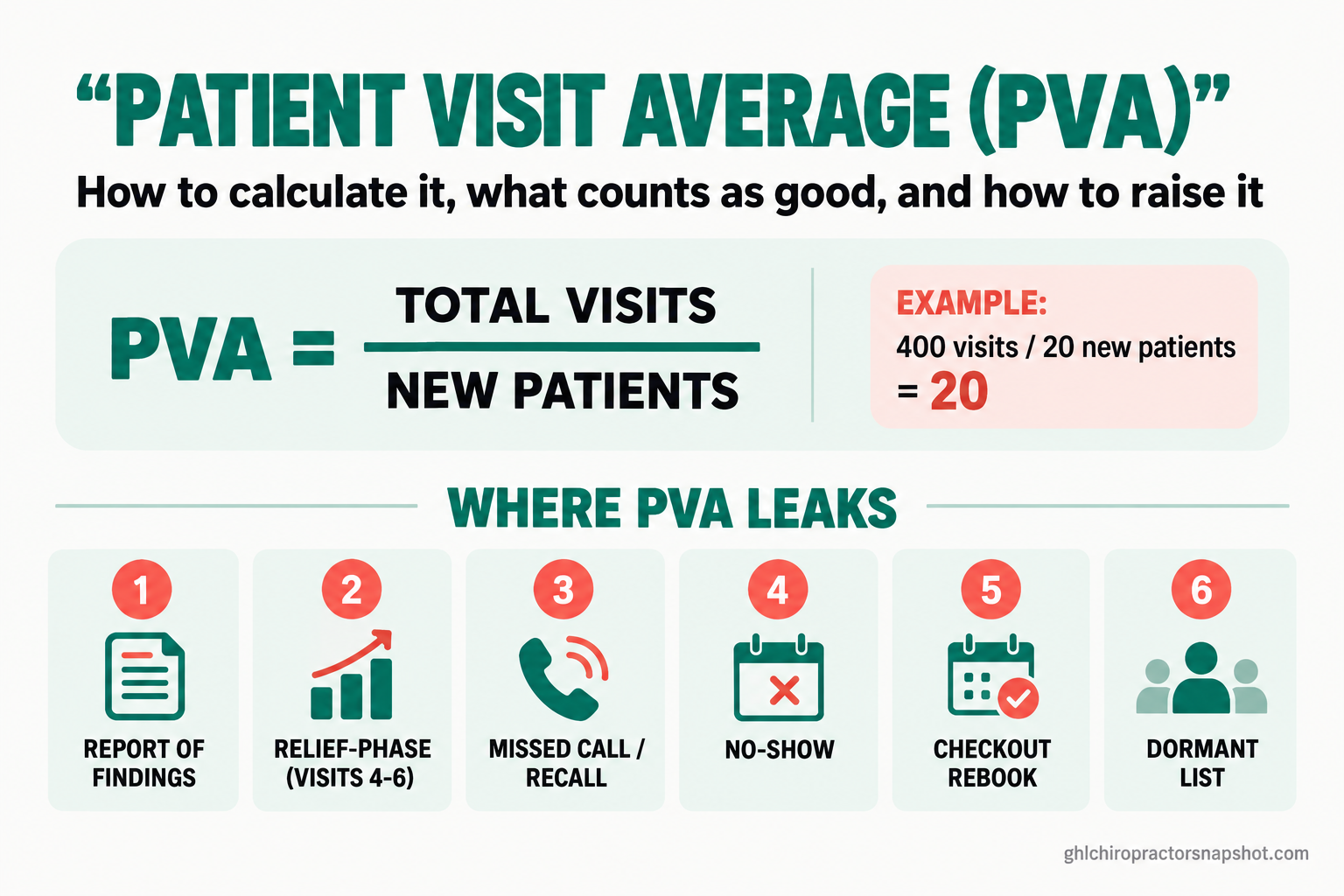
It is the last week of the quarter and two numbers do not add up. New patients are fine: you ran the ads, the phone rang, the schedule filled with first visits. But collections are flat and the afternoon columns have holes by Thursday. You are pouring patients in the top and they run out somewhere you cannot see. That somewhere is your PVA. Until you measure it, you are refilling a bucket without checking the holes, and new-patient marketing is the most expensive water you can buy.
Table of contents
- What PVA is and the exact formula
- What counts as a good PVA in 2026
- What a single point of PVA is actually worth
- The six places PVA leaks (and how to plug each)
- Steal this: the exact recall and rebooking copy
- Raise PVA three ways: solo, group, multi-location
- Staying compliant: HIPAA and TCPA on recall
- Common objections
- Frequently asked questions
What PVA is and the exact formula
Patient Visit Average answers one question: how many visits does a new patient complete before they stop coming? You take the total visits over a period and divide by the new patients who entered it. Consultant Rick Wren puts it plainly: total visits in a month or year divided by the number of new patients, so 400 visits divided by 20 new patients is a PVA of 20 (Planet Chiropractic).
That is the headline version. There is one catch, and it is where practices confuse themselves.
The cohort version is the honest one for a growth question: it tells you what happens to the patients you just spent money to acquire. To track it, once a quarter pull every new patient from a quarter that has fully closed out, count the visits those people made, and divide. That number is almost always lower than the rolling figure your software shows.
What counts as a good PVA in 2026
There is no independent, peer-reviewed national PVA figure. The numbers everyone quotes come from consultants and software vendors, and they do not fully agree. Treat the ranges below as directional, and weigh your own trend over time most.
Rick Wren states the US average PVA is about 12, and that an office running his full system should clear 30 (Planet Chiropractic). Cash-practice programs cite a national average closer to 16. A KPI guide sets 30-plus as the goal (PulseRevOps). None is a journal survey, but together they draw a consistent picture: most land in the low-to-mid teens, the strong ones roughly double that, and the gap is almost entirely retention.
Retention is where the industry quietly bleeds. Chiropractic runs patient attrition near 17% (ClinicMind, 2026) in a $24.0 billion market of about 66,061 businesses (IBISWorld, 2026), and about 14% of US adults saw a chiropractor in the past year (Gallup-Palmer survey). The demand is there. A low PVA is not a demand problem. It is a follow-through problem, fixable with systems rather than ad budget.
What a single point of PVA is actually worth
This section turns a ratio into the number on the bank statement. A visit collects roughly $40 to $75 for an insurance-mixed practice, with one KPI source citing a $75 average and $120-plus for cash (PulseRevOps); out-of-pocket adjustment pricing lands in a similar band (GoodRx). Use a modest $65 collected per visit below, then plug in your real one.
Lifting PVA from 12 to 18, a realistic jump from fixing the handoffs below, is $390 more from every patient you already paid to acquire. Across 100 new patients a year that is $39,000 you did not have before, with zero added ad spend. This is why PVA beats chasing cheaper clicks: acquisition is a race you pay for every lap, while PVA is a fix you make once and bank every month.
The six places PVA leaks (and how to plug each)
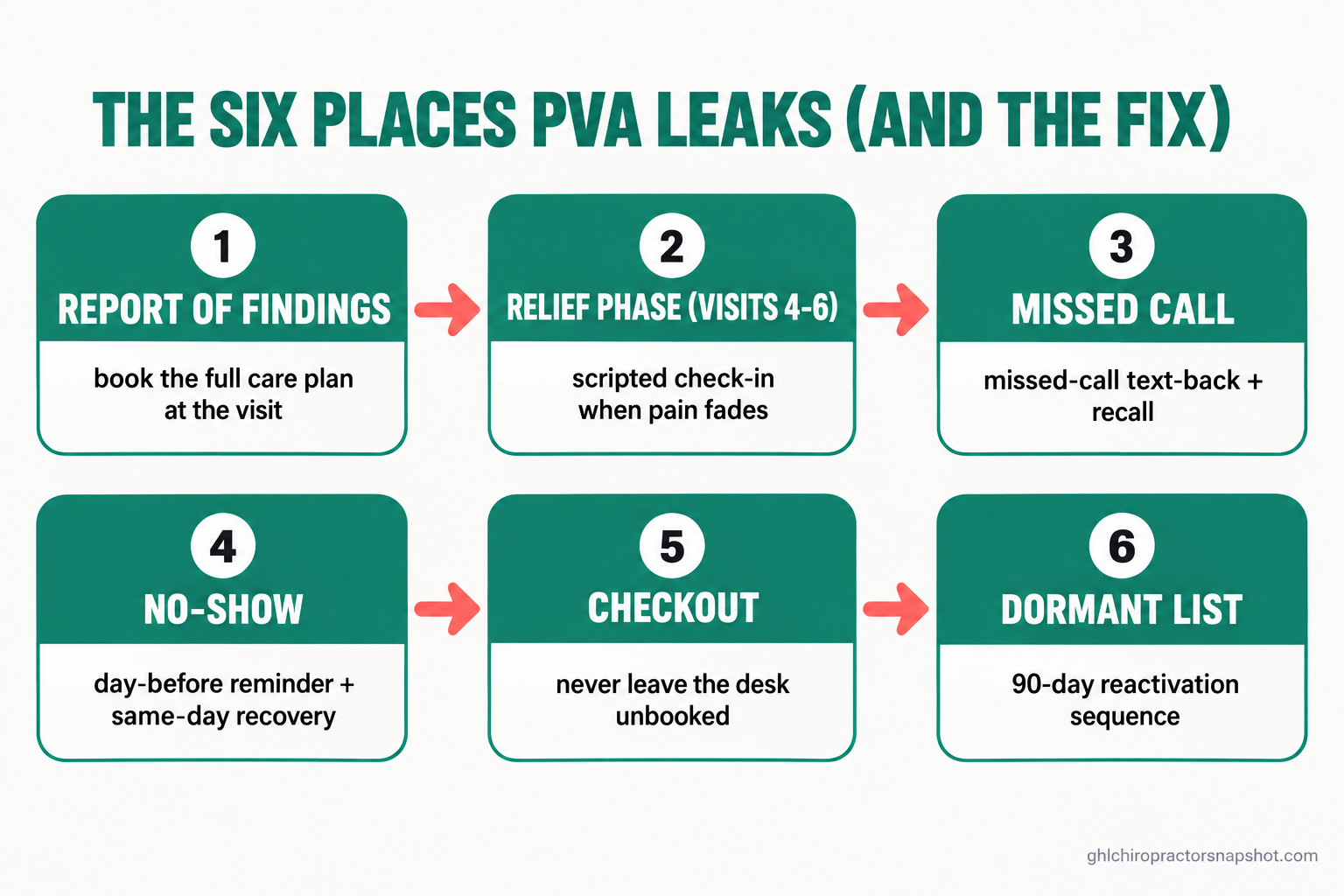
PVA does not fall because patients heal and graduate. It falls at six specific handoffs, and at each one a patient who would have kept coming quietly stops. Walk your own practice through these and you will usually find two or three wide-open holes.
Leak 1: The Report of Findings never converts the care plan
The biggest single drop happens before the plan even starts. If the first visit does not end with the patient understanding the problem, the plan, and why the frequency matters, they treat every future visit as optional. A vague “come back a few times and we will see” produces a PVA of 6.
The fix: standardize the ROF so every doctor delivers the same three parts (what I found, the plan and why this many visits, what happens if we stop early), then book the full plan at that visit. Failure mode: the plan is explained but never booked, so the patient leaves with intentions instead of appointments. See our Report of Findings script for the language.
Leak 2: The relief-phase handoff around visits 4 to 6
This is the famous cliff. Around visit 4 to 6 the acute pain fades and the patient quietly reclassifies you from “necessary” to “optional.” They feel better and do not grasp that relief is not correction. If no one re-sets expectations here, they ghost.
The fix: a scripted relief-phase check-in at the visit where pain typically drops, plus an automated nudge if they miss the next appointment (see the exact copy below). Failure mode: the team celebrates the patient feeling better and accidentally signals the job is done. We break this cliff down in why patients stop coming after visit 6.
Leak 3: The missed call that never gets a recall
Every call that rolls to voicemail during adjusting hours is a visit that may never get booked. Speed is the whole game: contacting a lead within five minutes rather than thirty makes you about 21x more likely to qualify it (MIT / InsideSales), yet the average business takes 42 hours to respond (Harvard Business Review).
The fix: missed-call text-back that fires in seconds, plus a standing recall workflow that reaches any active patient past their plan interval. Failure mode: the recall lives on a sticky note, so it happens on a quiet afternoon, which is never. Our missed-call text-back guide covers the setup.
Leak 4: The no-show that nobody recovers
A no-show is often the start of a drop-off: a patient who misses once and hears nothing assumes the relationship is over. Text reminders alone cut no-shows by 38% in one study (Klara, 2024), and a same-day recovery message turns many misses back into visits.
The fix: a confirm-or-reschedule reminder the day before, and an automatic “we missed you, let us grab a new time” within an hour of a no-show. Failure mode: the practice treats the no-show as the patient’s fault and waits for a call that never comes. See how to reduce no-shows.
Leak 5: Checkout that lets patients leave unbooked
The cheapest visit to book is the next one, at the desk, before the patient walks out. Yet countless practices let them leave with “call us to set up your next one.” Every patient who exits without a future appointment is a coin flip you did not need to take.
The fix: a hard rule that nobody leaves the desk without their next appointment booked, ideally the whole remaining plan. Failure mode: the desk is slammed, skips the rebook to clear the line, and the patient drifts.
Leak 6: The dormant list nobody works
Every practice sits on hundreds of patients who stopped coming and were never contacted again. That list is the highest-return PVA lever you own: these people already know you, trust you, and cost nothing to reach.
The fix: a 90-day reactivation sequence (text, email, and a call for your best past patients) that goes out on a schedule. Failure mode: the list is “too old” or “too awkward” to touch, so it sits there. It is not awkward to say you are thinking of them. See our patient reactivation campaign for the full sequence.
Steal this: the exact recall and rebooking copy
Keep every automated message HIPAA-aware (no diagnosis, condition, or treatment detail) and TCPA-safe (consent captured, opt-out on every message).
Relief-phase check-in (fires after the visit where pain typically eases):
“Hi [First name], glad you’re feeling better! Heads up: this is the stage where people feel good and stop, and it’s exactly when progress slips. Your next couple of visits lock it in. You’re set for [day/time], reply here to move it. Reply STOP to opt out.”
Missed-call text-back (fires within seconds of an unanswered call):
“Hi, this is [Clinic], sorry we missed you, we’re with a patient. Want us to call you right back, or grab a time here: [link] Reply STOP to opt out.”
No-show recovery (fires within an hour of a missed appointment):
“Hi [First name], we missed you today, everything okay? Let’s grab a new time so you don’t lose momentum: [link] Reply STOP to opt out.”
Checkout rebooking line (front desk, verbatim):
“Before you go, let’s get your next few visits on the calendar. Dr. [Name] wants to see you [frequency] for the next few weeks, mornings or afternoons easier?”
90-day reactivation text (for patients who lapsed):
“Hi [First name], it’s [Clinic]. We were thinking about you. If things have flared up again or you just want a tune-up, we’d love to get you back in: [link] Reply STOP to opt out.”
Every one stays on logistics and warmth, never clinical detail, which keeps them compliant in plain SMS. The human handles the room; the automation makes sure none of these six moments depends on someone remembering on a busy day.
Raise PVA three ways: solo, group, multi-location
The six leaks are the same at every size. Which ones hurt most changes with the practice.
Solo practice (one doctor, one or two staff). Your biggest leaks are 3 and 5: the missed call during adjusting hours and the checkout rebook that gets skipped when the desk is slammed. You cannot answer every call and rebook every patient by hand, so these two must be automated. Start with missed-call text-back and a non-negotiable rebook-before-you-leave rule, then add the relief-phase nudge.
Group practice (2 to 5 doctors, a front-desk team). Your biggest leak is 1, the Report of Findings, because consistency breaks down when several doctors each deliver it their own way. One doctor’s patients run a PVA of 25 and another’s run 9, and the practice average hides it. Standardize the ROF, measure PVA by provider, and coach the gap.
Multi-location or high-volume. Your leaks are 3 and 6: overflow calls that spill to voicemail when one site is busy, and a dormant list grown into the thousands that nobody owns. Centralize recall and reactivation so the same sequences run at every site, route overflow calls to whoever is free, and assign the dormant list to an owner with a monthly target. At scale, PVA is an operations problem, and the practice that systematizes it pulls away.
Staying compliant: HIPAA and TCPA on recall
Automated recall touches two sets of rules, both easy to follow.
HIPAA in plain messaging. Automated SMS and email should never carry diagnosis, condition, or treatment detail. “Time for your next visit” is fine; “time for your next lumbar adjustment” is not. Patients should also get written notice that unencrypted text and email can be intercepted, and give consent, before you message them that way (HHS HIPAA for professionals). Every template above stays on logistics.
TCPA on automated texts. Recurring texts need prior express consent and a working opt-out, which is why every message above ends with a STOP line (FCC on telemarketing and robocalls). Capture consent at intake and honor opt-outs instantly. Our HIPAA-compliant texting guide goes deeper.
Common objections
“My PVA is low because I run an evidence-based practice and discharge people when they are better.” Fair, and a low PVA from honest discharge is nothing to apologize for. But most low PVAs are not that. Pull your cohort and see where people stop: if the cluster is at visits 4 to 6 rather than a planned discharge, that is the relief-phase cliff, not clinical graduation. You can hold your ethics and still close the other leaks.
“Tracking PVA sounds like one more number I do not have time for.” It is one calculation a quarter, not a daily dashboard. Pull a closed-out quarter’s new patients, count their visits, divide. Fifteen minutes, four times a year, for the biggest lever on your collections.
“Do I need software to do any of this?” Not for the human parts. You can standardize your ROF and enforce a rebook-at-checkout rule tomorrow with nothing but a decision. The recall, no-show recovery, relief-phase nudges, and reactivation need something that fires automatically every time, which is where a GoHighLevel workflow build or a trained GoHighLevel VA earns its keep.
Frequently asked questions
How do you calculate PVA for a chiropractic practice?
Divide total visits in a period by the new patients in that period. 400 visits in a month from 20 new patients is a PVA of 20. For a true growth read, pull a quarter that has fully closed out, count only the visits those new patients made, and divide.
What is a good PVA for a chiropractor?
Consultant and vendor sources put the US average around 12 to 16 and set 30 or more as the target. These figures are directional, not peer-reviewed, so weigh your own trend over time more than any single benchmark. The gap between average and strong is almost entirely retention.
Why is my PVA low even though I get plenty of new patients?
A low PVA is a retention problem, not an acquisition problem. It usually leaks at one of six handoffs: a weak Report of Findings, the relief-phase window around visits 4 to 6, missed calls with no recall, unrecovered no-shows, unbooked checkouts, and a dormant list nobody works.
How much is one point of PVA worth?
It depends on your collected value per visit. At a modest $65 per visit, moving from a PVA of 12 to 18 adds about $390 per new patient, or roughly $39,000 a year across 100 new patients, with no new ad spend.
Can I raise PVA without spending more on marketing?
Yes, and that is the point. PVA rises by keeping the patients you already acquired: a consistent Report of Findings, relief-phase check-ins, automated recall and no-show recovery, a rebook-at-checkout rule, and a reactivation sequence. None of these need another ad dollar.
Is automated recall texting HIPAA and TCPA compliant?
It can be, when it stays on logistics with no diagnosis, condition, or treatment detail in plain SMS, patients have given written consent after notice about unencrypted messaging, and every message includes a working opt-out.
Related reading
- The Report of Findings script that turns consults into care plans
- Why patients stop coming after visit 6
- Chiropractic patient reactivation: the win-back campaign that refills your schedule
- Missed-call text-back: turn every missed call into a booked visit
- The chiropractic practice KPIs that actually predict growth
Back to that quarter-end report with the flat collections and the holes in the afternoon columns. The practice next door is not winning because it buys more patients than you. It is winning because the ones it buys stay twice as long. A PVA of 12 and a PVA of 24 can run the identical ad budget and the identical new-patient count, and one doubles its collections off the same spend. You do not need more water in the bucket. You need to find the six holes and plug them, and now you know where they are.